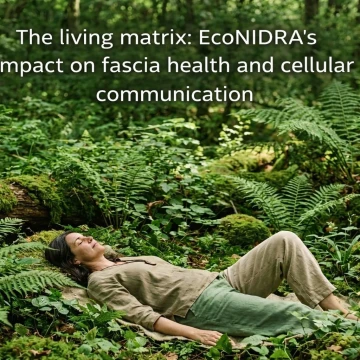
The Living Matrix: EcoNIDRA’s Impact on Fascia Health and Cellular Communication
For a long time, the scientific community treated fascia as little more than biological “packaging.” It was the silver skin you’d see on a piece of meat, the stuff surgeons would cut through to get to the “important” parts: the muscles, the bones, the organs. But as our understanding of human biology evolves, we are discovering that fascia is perhaps one of the most vital, intelligent, and communicative systems in the human body.
In the world of EcoNIDRA™, we often talk about connection: connection to the earth, to the cycles of nature, and to our inner landscapes. It turns out that this connection isn’t just a poetic sentiment; it is a physiological reality governed by what researchers now call the “Living Matrix.”
Beyond packaging: The liquid crystal highway
Today, we know that fascia is a sophisticated, body-wide communication network. It is a three-dimensional web of connective tissue that wraps around every muscle fiber, every nerve, and every organ. Rather than being a static container, it is a liquid crystal matrix. This means it has the capacity to conduct bio-electrical signals and information at speeds far exceeding the nervous system.
When we are healthy and vibrant, this matrix is hydrated, supple, and “gliding.” Information flows effortlessly from one part of the body to another. However, our modern lifestyle: characterized by chronic stress, digital overload, and a lack of varied movement: tends to “glue” this matrix together.

Under the influence of the sympathetic nervous system (our “fight or flight” mode), the fascia becomes dense and dehydrated. It loses its fluidity. Imagine a sponge that has sat in the sun too long; it becomes brittle and hard. In this state, the fascia traps toxins and hinders the flow of communication between cells. This isolation is what Dr. Zach Bush describes as a loss of “oneness” within the body’s community of cells. He suggests that many modern diseases, including cancer, can be viewed fundamentally as a “communication issue” where cells become isolated from the whole organism, forgetting they are part of a larger, supportive collective.
EcoNIDRA™ and the art of re-hydration
How do we begin to “unstick” this matrix? While physical movement like stretching or foam rolling helps, the deepest shifts often happen when we go horizontal and enter a state of profound, restful awareness.
EcoNIDRA™ is a unique fusion of Yoga Nidra and Forest Therapy techniques. It is designed to move the practitioner out of the “inner buzz” of daily stress and into a state of hypometabolism. This isn’t just “sleep”; it is a specific physiological state where the body’s energy is redirected from external survival to internal maintenance and regeneration.
When you practice EcoNIDRA™, especially when you experience EcoNIDRA in a nature-immersed state, you are sending a systemic signal of safety to your fascia. Through the practice of body sensing: one of the core journeys of an EcoNIDRA™ session: you bring conscious attention to various parts of the body without the need to “do” anything. This soft, receptive awareness encourages the fascia to relax and, crucially, to re-hydrate.
As the fascia softens, it clears the pathways of the Extracellular Matrix (ECM), allowing the “liquid” in the liquid crystal to flow once more. You are essentially “watering” your internal garden.
The science of restful awareness
Recent fMRI research into Yoga Nidra (a foundational element of our practice) has provided fascinating insights into what happens in the brain during this state. A 2024 study published in Nature showed a “decoupling” of the Default Mode Network (DMN). The DMN is the part of the brain responsible for our sense of “self,” for ruminating on the past, and worrying about the future.
When the DMN settles, we enter a state of “restful awareness.” In this space, the body can facilitate a process called mechanotransduction. This is the biological process by which cells sense and respond to mechanical changes in their environment. When your fascia relaxes during an EcoNIDRA™ session, your cells literally “feel” the change in tension.
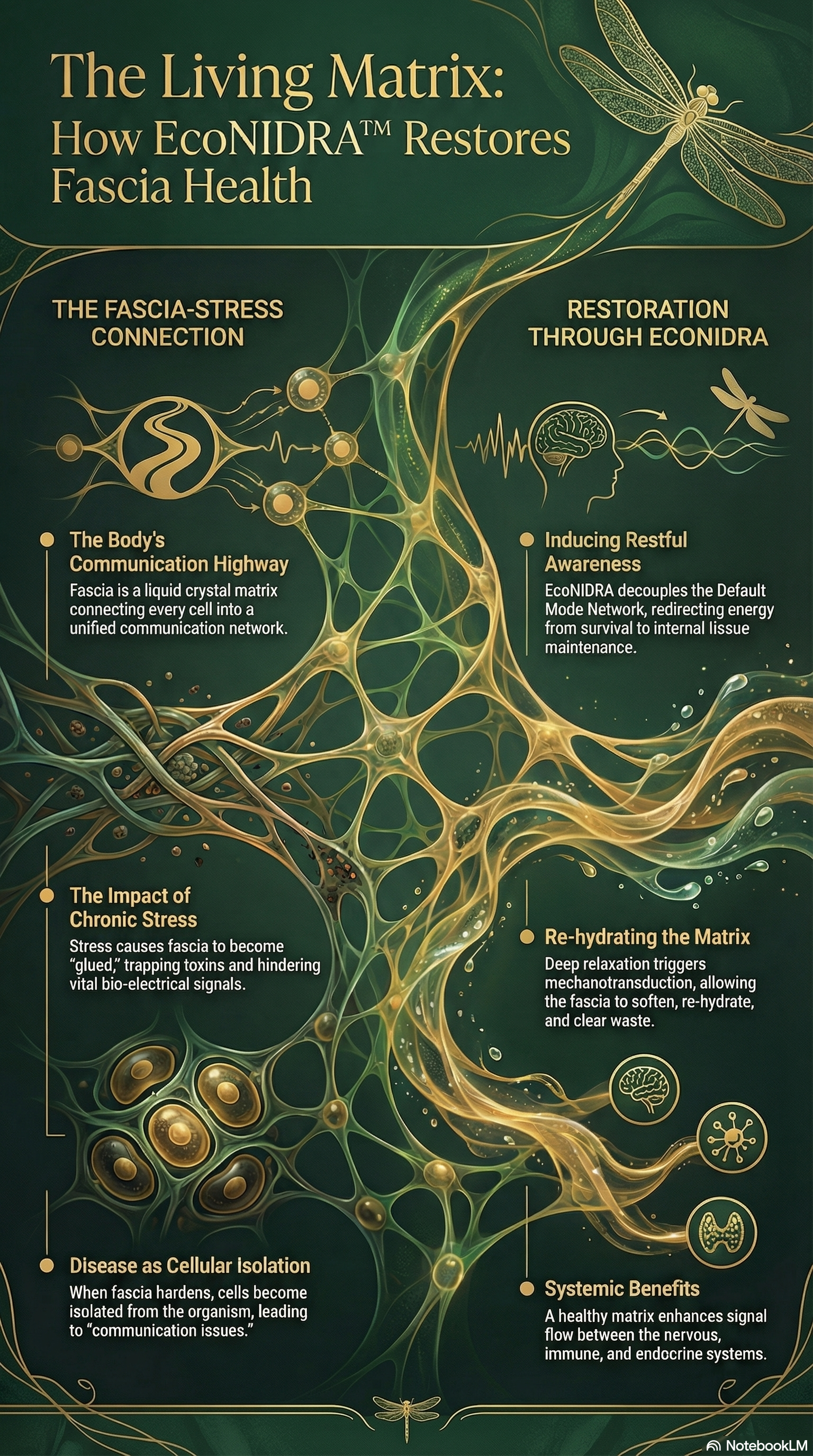
This shift sends “safety signals” to every cell. It tells the cellular community that the drought is over, the tension has passed, and it is safe to reconnect with the whole organism. This is the physiological bridge to the felt sense of “no separation” that we often experience when practicing in nature.
The benefits of a resilient matrix
By regularly engaging in deep, nature-based rest, we cultivate a more resilient living matrix. This has profound implications for our overall wellbeing:
Enhanced signal flow: A hydrated, healthy fascia allows for faster and clearer communication between the nervous, immune, and endocrine systems. Your body starts talking to itself again.
Natural detoxification: By “unsticking” the fibers of the fascia, EcoNIDRA™ allows the lymphatic system to effectively flush metabolic waste from the extracellular space. It’s a deep internal spring cleaning.
Holistic wholeness: We move from a state of isolation (where the body feels fragmented and “stiff”) to a state of integrated community. This provides the fertile ground for vitality to flourish.
For the guides and space-holders
If you are a coach, therapist, or wellness professional, understanding the science of the “Living Matrix” adds a powerful layer to your work. When we invite our clients to lie down and connect with the sound of the wind or the feeling of the earth beneath them, we aren’t just offering a “nice break.” We are facilitating a deep, cellular recalibration.
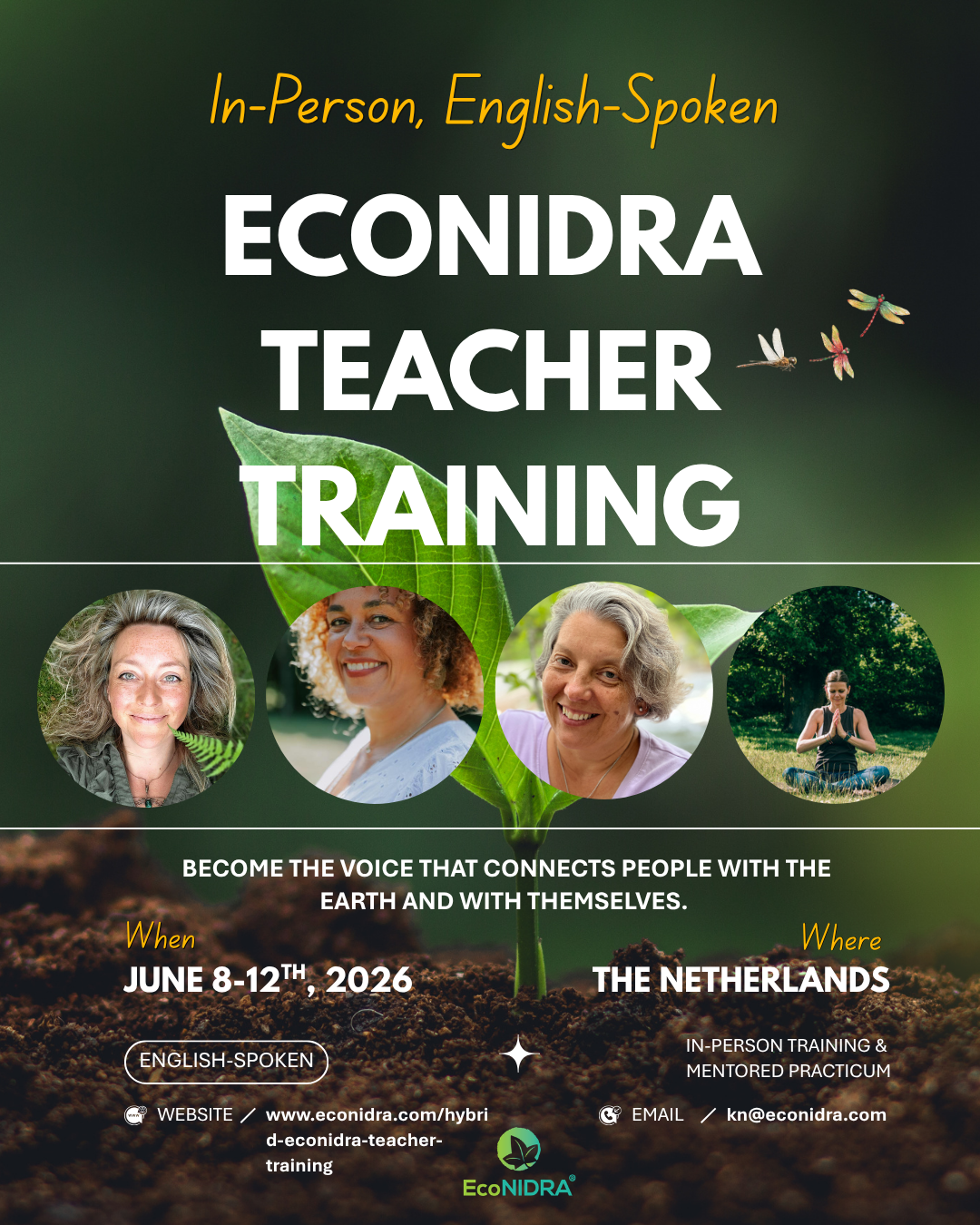
In our EcoNIDRA™ Teacher Training, we dive deep into this science, exploring how to guide others into these states of deep restoration. We teach you how to use nature as a co-guide, using sensory cues to bypass the analytical mind and speak directly to the fascia and the nervous system.
A practice of radical regeneration
In a world that prizes “doing” and “optimizing,” choosing to go horizontal is a radical act. It is an acknowledgment that we are not machines, but biological organisms that require periods of deep, receptive quiet to function.
Whether you are practicing in your living room with a “nature being” like a potted plant, or lying on a bed of moss in an ancient forest, you are participating in the ancient rhythm of the living matrix. You are giving your body the chance to remember its own oneness.
You are welcome to explore this connection further. Perhaps today, you might take five minutes to simply feel the weight of your body against the floor, noticing the subtle “buzz” of your cells, and inviting a sense of softness into the web of your being.
Scientific References:
Datta, K., et al. (2023). “Improved sleep, cognitive processing and enhanced learning and memory task accuracy with Yoga nidra practice in novices.” PLOS ONE.
Fialoke, S., et al. (2024). “Functional connectivity changes in meditators and novices during yoga nidra practice.” Scientific Reports (Nature).
Mallick, H. N. (2022). “Electrophysiological Evidence of Local Sleep During Yoga Nidra Practice.” Frontiers in Neurology.
Pandi-Perumal, S. R., et al. (2022). “The Origin and Clinical Relevance of Yoga Nidra.” Sleep and Vigilance.
Bush, Z., MD. “The Extracellular Matrix and Cellular Communication in Disease.”
Schleip, R., et al. “Fascia: The Tensional Network of the Human Body.”
Go Yoga USA (2025). “The Science Behind Yoga Nidra: Why This Deep Rest Practice Works.”
Are you ready to share the gift of deep rest? Discover our Teacher Training and join a global community of guides dedicated to nature-based restoration.
Geschreven door
Kat Mertens