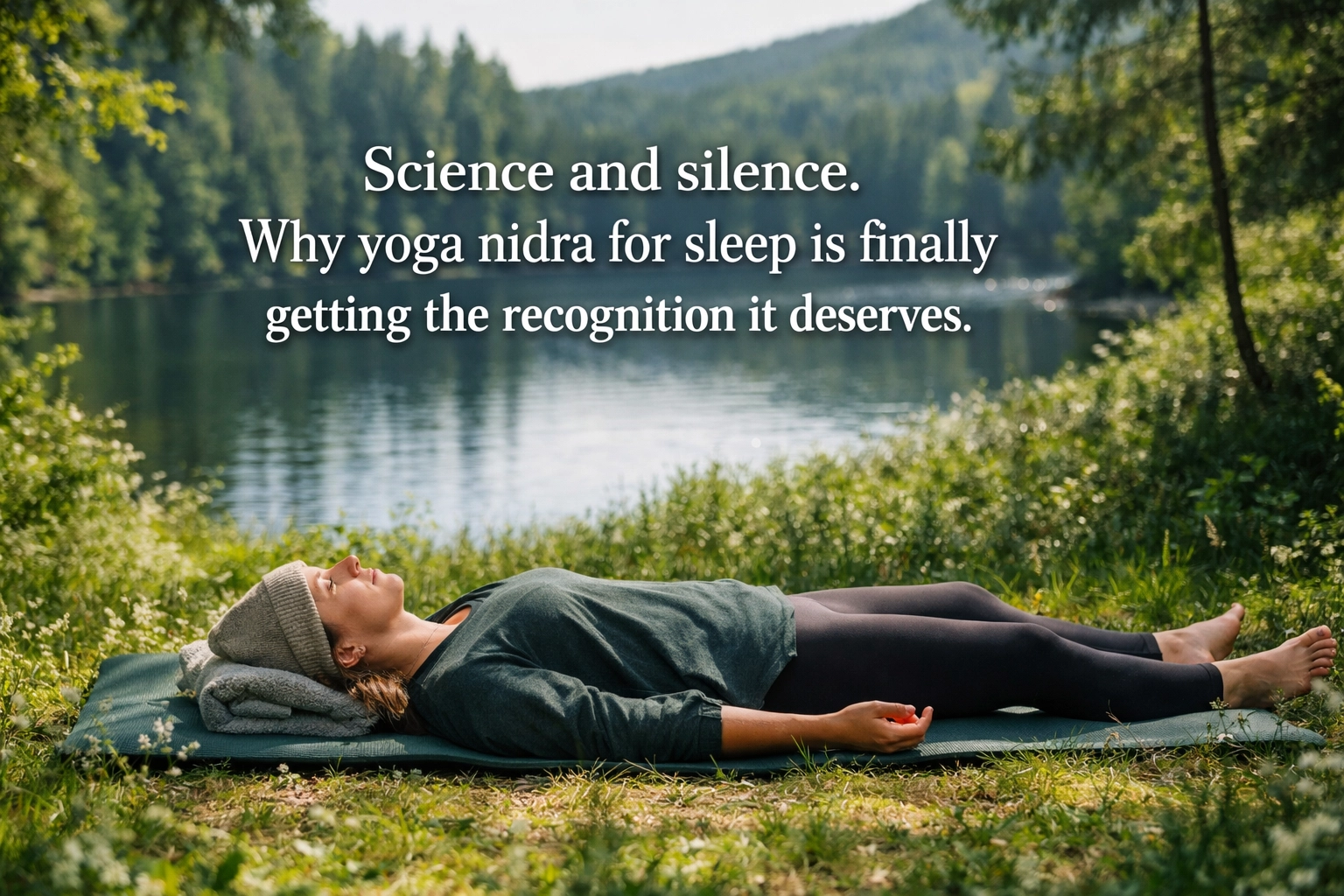
Science and silence. Why yoga nidra for sleep is finally getting the recognition it deserves.
Rest can start to feel like something you have to earn. You push through the day, your mind a humming hive of to-do lists and digital pings, waiting for that final moment when you can drop into bed. And yet, when the lights are out and the room is still, the internal motor is still running. You’re physically horizontal, but your nervous system is still standing up, pacing the room, checking the locks.
If you know this feeling, you’re not alone. It’s a specific kind of depletion where sleep feels like a shore you can see but never quite reach. You might have tried meditation, breathwork, or gentle movement, and while those practices are beautiful and vital in their own right, sometimes the gap between a high-alert brain and a truly restful state feels too wide to bridge with effort alone.
This is where the ancient wisdom of yoga nidra for sleep begins to whisper a different story. If you are searching for yoga nidra for sleep, you may already sense that rest is not only about falling asleep faster, but about helping the whole nervous system remember how to soften. And lately, something has shifted. The world is finally catching up to what practitioners have known for centuries: there is real science behind this silence. Yoga nidra is no longer dismissed as a “nice to have” relaxation at the end of a class. It’s being recognized as a sophisticated tool for nervous system regulation, backed by data and felt in the very marrow of our bones.
What is the physiology behind yoga nidra for sleep?
When we talk about yoga nidra for sleep, we are talking about the biology of the "in-between." In our modern lives, we are often stuck in a state of sympathetic dominance. This is the "fight or flight" mode: useful for escaping tigers, less useful for sending an email or cooking dinner. When we stay in this state for too long, our nervous system loses its elasticity. We become brittle.
Science is now showing us that yoga nidra acts as a bridge to the parasympathetic nervous system: the "rest and digest" state. Recent research suggests that even a morning practice of yoga nidra can reduce sympathetic drive and increase parasympathetic tone throughout the day. This creates a ripple effect. By calming the waters of the nervous system during the day, we prepare the fertile ground for deep, restorative sleep at night.
One of the most fascinating discoveries in sleep labs is the presence of delta brainwaves during yoga nidra. Typically, delta waves are associated with the deepest stages of dreamless sleep. They are the waves of healing and physical restoration. In a yoga nidra session, participants often enter this delta frequency while remaining conscious. It is a state of "dynamic sleep" where the body rests as deeply as if it were in a profound slumber, yet the mind remains a quiet observer.

What makes yoga nidra for sleep more than just closing your eyes?
It is important to hold space for the distinction between different practices. Meditation often requires a level of focused attention or "sitting with" what arises. Yoga nidra, however, is a practice of systematic letting go. It is not about doing, it is about receiving. For a nervous system that is already overtaxed, the invitation to simply lie down and be guided can be a profound act of kindness.
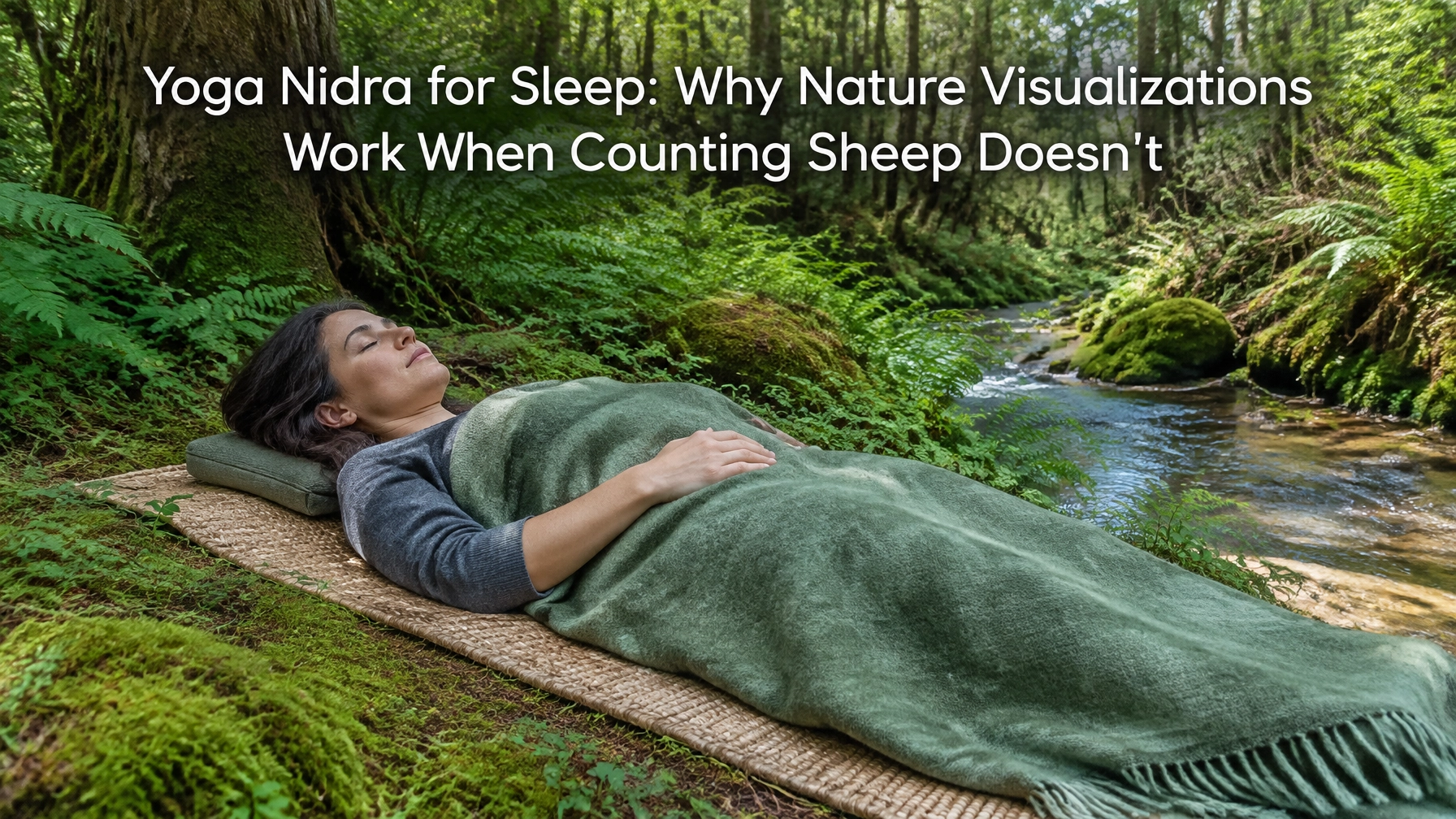
In EcoNIDRA, we take this further through a unique, equal fusion of ancient Yoga Nidra and scientific Forest Therapy techniques. Nature isn’t just a backdrop: it’s part of the methodology. We work with evidence-informed ways of “being with nature” (through sensory orientation, gentle attention cues, and relational nature connection) while also using the classic yoga nidra structure to guide the system into deep downshifting.
Practically, this can look like letting the sounds of the forest co-regulate you, feeling the rhythm of wind in the canopy, and sensing the ground as a steady support. Those natural signals often land as “safe” in the nervous system: birdsong, rustling leaves, the soft unpredictability of weather. It’s an old recognition. And when the world around you is allowed to co-guide the practice, your own breath often finds its natural, easy rhythm again.

What does the research tell us about yoga nidra for sleep?
The numbers are beginning to reflect the lived experience of millions. Studies have documented that yoga nidra can significantly increase sleep efficiency. This means less time spent tossing and turning, and more time spent in the restorative phases of sleep. In investigations with people experiencing chronic insomnia, a staggering 89% of participants were able to find sleep through the practice.
For wellness professionals, these statistics are more than just data points: they are a call to action. Whether you are a coach, a therapist, or a yoga teacher, understanding the mechanics of nervous system regulation is becoming essential. We are living in a time of collective exhaustion. Our clients are not just looking for "stretches" or "tips": they are looking for a way to return to themselves.
Research also shows that yoga nidra improves cognitive performance and reaction times. By giving the brain a total "offline" moment during the day, we clear the digital fog. We reclaim our clarity. It is a gentle approach to burnout that doesn't ask for more "work." It simply asks for a few minutes of horizontal presence. If you want to explore how nature-based imagery can support this process, you are welcome to read our related journal article.
What are the three journeys of restoration?
In the way we share this work at EcoNIDRA, we look at restoration as a triple thread. We don't just focus on the sleep aspect: we focus on the whole human being in connection with the whole earth.
The journey through the senses: We begin by opening the doors of perception. We listen to the furthest sounds and the closest breath. This helps the nervous system to map its environment and realize it is safe.
The pilgrimage through the body: We move awareness through the physical form. This systematic rotation of consciousness is what triggers the shift in brainwaves. We are not "thinking" about the body: we are feeling it from the inside out.
The journey through the earth: We connect our physical rest to the resting state of the planet. We visualize roots, we feel the support of the soil, and we remember that we are part of a larger ecosystem that knows how to cycle through seasons of activity and seasons of deep, dark rest.

Why does yoga nidra for sleep matter for the modern professional?
If you work in the wellness space, you likely see the toll that modern life takes on your clients. You see the tired eyes and the hunched shoulders. You might even feel it in yourself. Integrating yoga nidra for sleep into your offerings is not about replacing what you already do. It is about adding a layer of deep, physiological support.
When a client is in a state of high stress, they often cannot "think" their way out of it. Their prefrontal cortex is offline. By using a practice that speaks directly to the autonomic nervous system, you are bypassing the chatter of the mind and going straight to the source of the tension. You are providing a sanctuary where they don't have to perform.
This is why our EcoNIDRA Teacher Training focuses so heavily on the marriage of science and soul. We want our teachers to understand why the heart rate drops and why the breath slows: and we want them to be able to hold that space with a nurturing, earthy presence.
Will you accept the invitation to the quiet?
As the world becomes louder and more demanding, the value of silence and deep rest only grows. We are witnessing a revolution in how we view sleep. It is no longer seen as a "waste of time" but as the very foundation of our mental and physical health.
You are welcome to explore this for yourself. You might like to find a quiet corner, perhaps near a window where you can see a tree or some sky. You might like to lie down and simply notice the weight of your body against the floor. There is nothing to fix in this moment. There is no one you need to be.
The science confirms it: the earth supports it: and your nervous system is longing for it. The recognition that yoga nidra is receiving today is a sign that we are finally ready to value the "being" as much as the "doing."
If you feel called to bring this medicine to others, to lead them through the forest of their own subconscious and back to the peace of the present moment, we would love to have you in our community. The trees have been waiting: and the silence is ready to speak.

You can find more about our path and the way we weave these ancient threads together in our journal or by exploring our teacher training program. Let’s rediscover the art of rest, together.
Geschreven door
Kat Mertens