
Outdoor meditation: what shifts when you take yoga nidra off the mat and into the woods
There is a particular moment in an outdoor meditation when the boundary between “you” and the place around you begins to soften.
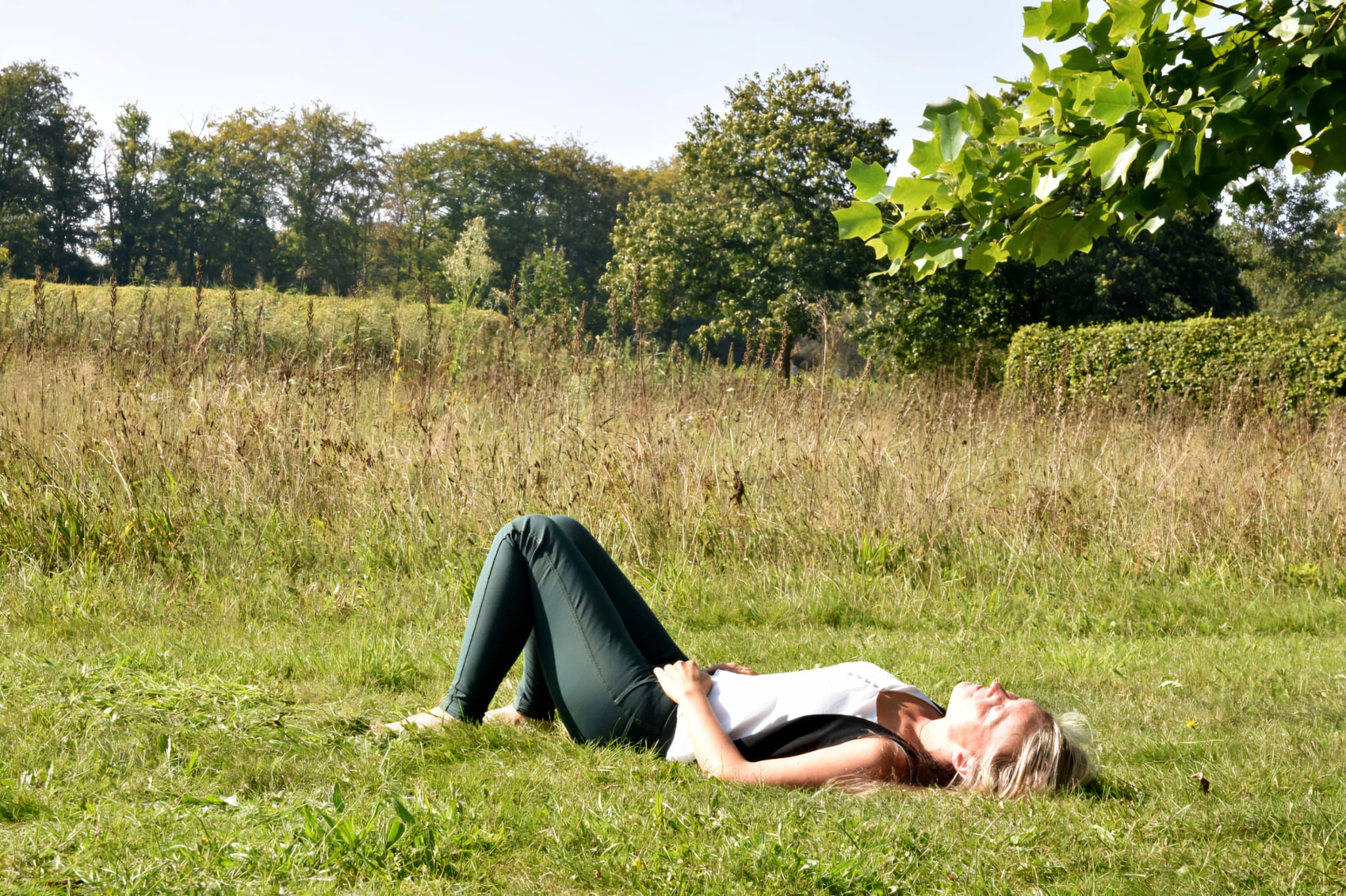
Perhaps you are lying on your back beneath a tree. Your body is supported by the earth, your eyes are closed, and a guided yoga nidra is slowly leading your attention through the body. Somewhere nearby, a bird calls. Grass moves in the wind. The temperature changes slightly across your skin.
You are not trying to meditate harder. You are not working at wellness.
You are resting, while the forest quietly participates.
This is what can shift when yoga nidra moves outdoors. The practice itself remains a guided journey through the body, breath, awareness and imagination. Yet the sensory field becomes wider, the nervous system receives different information, and relaxation can take on a deeply relational quality.
EcoNIDRA™ is born from this meeting place. It is a unique fusion of Yoga Nidra and Forest Therapy techniques, enriched by nature-based visualisations and authentic soundscapes. Yoga Nidra offers the structure for deep rest. Forest Therapy opens the senses to relationship with the living world. Together, they create a practice of restoration and belonging.
The first shift is sensory
Indoor spaces can be wonderfully supportive. A quiet room, a blanket and a comfortable place to lie down may be all that is needed for a profound practice.
Outdoors, however, the body is met by a constantly changing landscape of sensation.
You may notice:
The uneven support of the ground beneath your shoulders and hips
The warmth of sunlight on one side of your body
A cooler current of air moving across your face
The scent of damp soil, pine needles or wild grasses
The sound of leaves, insects, distant footsteps and birdsong
The feeling of space above you, rather than a ceiling
Small movements in the environment that continue without asking anything of you
In a typical guided yoga nidra, attention is invited to move through the body in a gradual rotation. Outdoors, this inner awareness meets an outer world that is also alive with detail.
You might feel the weight of your heels and, at the same time, sense the weight of the earth beneath you. You might notice the rhythm of your breath while hearing the rhythm of wind through the canopy. You might feel the texture of your clothing against your skin and then become aware of the roughness of bark beneath your hand.
This is mindfulness in nature in an embodied sense. Not simply looking at a beautiful landscape, but allowing the senses to remember that you are already part of one.

The second shift is physiological
Many of us spend large parts of the day receiving signals of urgency. Notifications, bright screens, traffic, deadlines and continuous mental input can keep the nervous system oriented towards response.
A slow, guided practice offers another message: there is nothing you need to solve right now.
Yoga nidra is traditionally practised lying down, with the body supported and the mind guided through layers of awareness. This can create the conditions for the parasympathetic nervous system, often described as the rest-and-digest branch of the autonomic nervous system, to become more active.
Research into yoga nidra is still developing, and studies vary in quality and design. The existing evidence is promising rather than conclusive. Research has explored changes in perceived stress, sleep, wellbeing and cortisol patterns. Broader meditation research also associates deeply relaxed states with increased alpha and theta brain activity, although the specific effects of outdoor yoga nidra on brain waves require further study.
Nature exposure adds another dimension. Studies on forest bathing and natural soundscapes have explored changes in stress, attention, mood, blood pressure and cortisol. Some research suggests that natural sounds can support stress recovery and a shift towards parasympathetic activity, compared with more disruptive environmental noise.
You can explore the research behind EcoNIDRA™ on our science and evidence page, including studies on yoga nidra, nature sounds and nature-based guided imagery.
None of this means that one outdoor meditation guarantees a particular biological outcome. Human beings are not machines, and our responses change according to context, health, history, weather, safety and the quality of the guidance.
Still, many people recognise the felt sense of the shift. The jaw loosens. The breath becomes less managed. The muscles no longer seem to be preparing for the next demand. The mind may remain active, but it is no longer carrying everything alone.
The third shift is relational
Indoor yoga nidra can support a powerful connection with the inner landscape. Outdoors, the practice may also invite a sense of being accompanied.
A tree is not merely scenery. Wind is not simply background noise. The ground is not only a surface beneath the body.
In EcoNIDRA™, nature co-guides the practice. This does not require a particular belief system or an idealised relationship with nature. It may be as simple as partnering with one natural presence for the duration of the session.
You might choose:
A tree whose shape catches your attention
A patch of moss
A nearby stream
The movement of grasses
A particular bird call
The changing light between the branches
As the teaching moves slowly through the body, you can allow this nature being or element to remain part of your awareness. You do not need to interpret it. You do not need to make it meaningful. You can simply notice what changes when you are resting beside it.
This is one of the quiet gifts of outdoor meditation. Rest is no longer experienced only as something you do for yourself. It becomes a way of remembering relationship.

The three journeys of EcoNIDRA™
An EcoNIDRA™ session gently moves through three interconnected journeys.
The first is a journey towards your inner nature. Through the body, breath, senses and awareness, you are invited to come home to what is already present beneath the layers of tension and mental noise.
The second is a journey towards relationship. You may become more aware of the people, beings and communities that support your life. This can include the group around you, your loved ones, and the more-than-human world.
The third is a journey with the natural world. Nature-based visualisations and soundscapes can help you experience the earth not as an object of observation, but as a living context of which you are a part.
These journeys are not separate stages that you need to complete correctly. They overlap, circle back and unfold at their own pace.
The teaching remains slow and embodied. There is space to feel, to notice, to drift, to listen and to receive. You are not being asked to concentrate perfectly. You are not trying to produce a special state.
This is important for wellness professionals and practitioners who are used to supporting others. Outdoor yoga nidra is not another method to perform flawlessly. It can offer a different relationship with facilitation, one in which your role is to create the conditions for rest and allow nature to do some of the guiding.
What actually changes for the participant?
The most noticeable change may be that the body is invited to trust its surroundings in a different way.
In a room, relaxation can come from familiarity and containment. In a forest or meadow, relaxation may develop through sensory orientation. The participant hears the world continuing around them and gradually discovers that they do not need to monitor every sound.
A branch moves. Nothing needs to be done.
A bird calls. Nothing needs to be answered.
The weather shifts. The body adapts.
For someone experiencing digital overwhelm, this can be particularly meaningful. There is no screen to scroll, no stream of content to process and no algorithm deciding what should receive attention next. The senses return to their original, human pace.
The practice may also deepen a felt sense of belonging. Instead of trying to escape the body or transcend ordinary life, you are resting within it, on the earth, beneath the sky, among other living beings.

You do not need special equipment
Outdoor EcoNIDRA™ is accessible to many different bodies and circumstances.
No physical condition, flexibility or previous meditation experience is required. A session can be practised lying down in any comfortable position. A mat may be helpful, but it is not essential. You can use a blanket, a hammock, a supportive chair or whatever allows your body to feel at ease.
And when going outdoors is not possible, the practice can still be offered indoors or online. Nature can be invited through soundscapes, sensory awareness and nature-based visualisation. The location changes, but the essential relationship remains available.
For practitioners, this flexibility makes EcoNIDRA™ relevant in many settings, including private practice, yoga studios, healthcare environments, schools, workplaces, retreats and community programmes.
A gentle invitation to begin
The next time you are outside, you might take a few minutes to lie down or rest in a supported position.
Notice the shape of the sky.
Feel the temperature at your skin.
Listen for the furthest sound you can hear, and then the nearest.
Sense the texture beneath your body.
Notice whether your breath changes when you allow the land to support you.
There is no need to turn this into a perfect meditation. Let it be a small act of remembering.
For those who feel called to guide others, the certified online blended EcoNIDRA™ Teacher Training offers a spacious, self-paced pathway into this work. The hybrid teacher training combines immersive in-person days with a mentored integration period. Both formats explore the fusion of Yoga Nidra and Forest Therapy, the science of deep rest, nature soundscapes, radically invitational language and the practical art of creating safe, nourishing sessions outdoors, indoors or online.
Perhaps outdoor meditation begins with taking yoga nidra into the woods.
Perhaps, over time, it becomes something quieter and more lasting: the discovery that rest is not a retreat from life, but a way of meeting life more fully.
With the earth beneath you, the living world around you and your own human nature gently returning, you are welcome to begin.
Geschreven door
Kat Mertens