
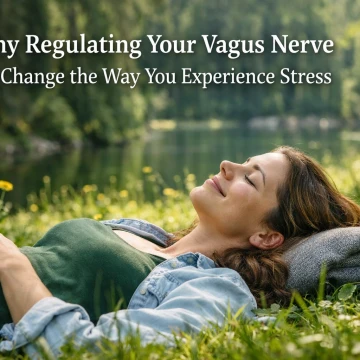
Why Regulating Your Vagus Nerve Will Change the Way You Experience Stress
I remember one Tuesday some months ago. My heart was acting like a hummingbird trapped in a cage. Too much coffee, too many emails, and that heavy, familiar weight of “doing” that never seemed to lift. It wasn’t just that I was busy, it was a physical vibration of not-enough-time humming under my skin. Have you felt that? That buzzing sensation that says you are running a race, even when you are sitting perfectly still at your desk?
I used to think that was just how life felt. I thought stress was an external force, something that happened to me, like rain or a flat tire. But then I began to listen to the whispers of my own body, and I discovered the wanderer within.
I’m talking about the vagus nerve. It is the longest nerve in your body, a soulful, winding path that begins at the base of your brain and meanders down through your throat, your heart, your lungs, and deep into your belly. In the world of nervous system regulation, the vagus nerve is the primary highway for peace. It is the CEO of your parasympathetic nervous system, the “rest and digest” state that we so often neglect in our modern, frantic lives.
When we learn how to communicate with this nerve, the way we experience stress shifts from being a victim of our circumstances to being a gardener of our own internal landscape.
The biology of the “on” switch
Most of us spend our days with our “on” switch stuck in the downward position. This is the sympathetic nervous system, the “fight or flight” response. It’s useful if you’re being chased by a bear, but it’s incredibly depleting when it’s triggered by a notification on your phone or a long to-do list.
When this system stays active for too long, our bodies become fertile ground for exhaustion. Our heart rate stays high, our breath becomes shallow and moves up into the chest, and our digestion slows down because the body thinks it needs all that energy to escape a threat. This is where stress reduction techniques become more than just a luxury, they become a necessity for survival.

The vagus nerve is the counterbalance. It is the “brake” system. When the vagus nerve is active, it sends a clear, physiological message to every major organ: You are safe. You can soften. You can repair.
The secret of vagal tone
In scientific circles, we talk about “vagal tone.” You can think of it like the fitness of your relaxation response.
High vagal tone means your body can pivot quickly. You might have a stressful moment, a disagreement or a deadline, but your body knows how to come back to center almost immediately. Your heart rate slows down, your muscles let go of their grip, and your mind clears.
Low vagal tone, on the other hand, means you stay “spiked” long after the stressor has passed. You might still be feeling the physical tension of a morning argument at dinner time.
The beauty of working with the vagus nerve is that it doesn’t eliminate stress. Life will always have its thorns. But regulating your nervous system changes how quickly and how completely you recover. It builds resilience, making you a sturdy tree that bends in the wind rather than a dry branch that snaps.
A pilgrimage through the body
In our EcoNIDRA practice, we use several pathways to reach this nerve. One of the most profound is what I call the pilgrimage through the body.
Imagine lying down, perhaps on a soft rug or out on the damp, fragrant grass. You aren’t “working” at wellness. You are simply receptive. As a guide, I invite you to bring your awareness to specific parts of your body, the jaw, the throat, the heart center, the solar plexus.

This isn’t just a mental exercise. These are the very areas where the vagus nerve branches out. By bringing a soft, non-judgmental attention to these spaces, you are physically signaling to the nerve that it is okay to engage. You are inviting the parasympathetic system to take the lead.
In a typical 30 or 45-minute EcoNIDRA session, about one-third of the journey is bathed in pure nature sounds. This is intentional. The human ear and the human nervous system have evolved over millennia to find safety in the sound of wind through leaves or the rhythmic lap of water. These sounds are a direct “hello” to the vagus nerve, bypassing the analytical mind and going straight to the ancient, instinctive parts of our being.
Why nature is the ultimate co-guide
We often talk about “practicing in nature,” but in the EcoNIDRA Teacher Training, we see nature as more than just a backdrop. Nature is a co-teacher.
When we engage in the journey through the senses, we might notice the texture of the air on our skin or the scent of damp earth. This sensory grounding is a powerful way to regulate the nervous system. The vagus nerve responds beautifully to the “now.” It cannot be regulated in the future (the land of anxiety) or the past (the land of rumination). It can only be regulated in the present moment, through the senses.
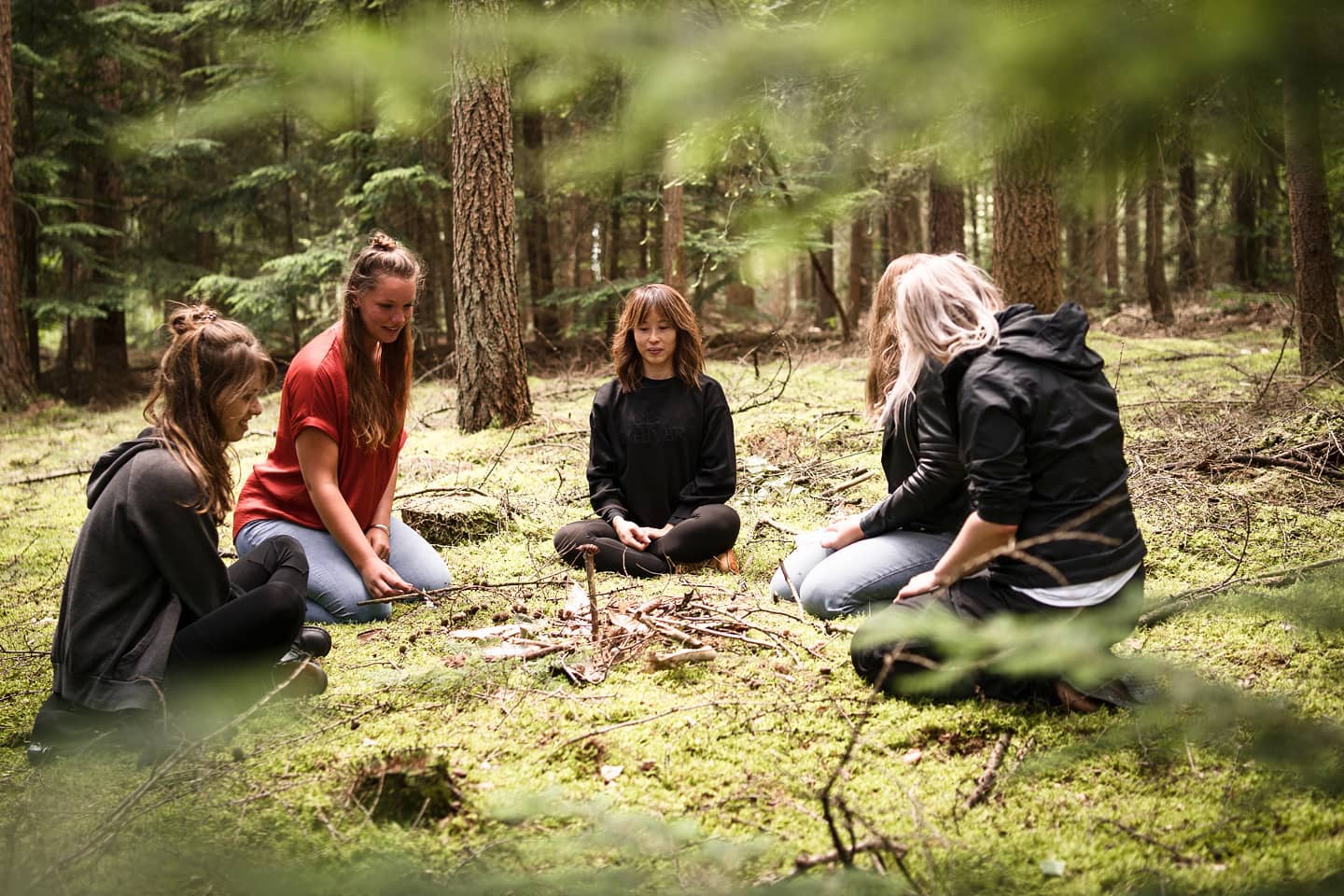
If you are a wellness professional, a coach, or a therapist, you might recognize this in your own work. Your clients aren’t just looking for advice, they are looking for a way to feel safe in their own bodies again. When you understand the science of the vagus nerve, you stop trying to “fix” their thoughts and start helping them settle their physiology.
Our EcoNIDRA Teacher Training is designed specifically to give you the tools to facilitate this deep, somatic rest for others, blending the ancient wisdom of Yoga Nidra with the grounding science of forest bathing.
Small seeds of regulation
You don’t always need a full hour to begin this work. You can plant small seeds of regulation throughout your day.
The Long Exhale: The vagus nerve is intimately connected to your breath. When you inhale, your heart rate speeds up slightly. When you exhale, it slows down. By making your exhale longer than your inhale, you are manually triggering the vagus nerve to slow the heart. Try breathing in for four, and out for eight.
Cold Water: A splash of cold water on the face or the back of the neck can provide a gentle “reset” for the nervous system.
Humming or Chanting: Because the vagus nerve passes through the vocal cords, the vibration of humming or singing is a direct physical stimulation of the nerve. It’s why we feel so much better after a good song.
Connecting with a Nature Being: Find a tree, a plant, or even a stone. Spend a few minutes simply being with it. Notice its edges, its stillness. Allow your nervous system to mirror its groundedness.
The shift from doing to being
The most radical thing about nervous system regulation is that it requires us to stop trying so hard. We are so used to “working” on ourselves, trying to “achieve” relaxation.
But the vagus nerve doesn’t respond to force. It responds to invitation. It responds to softness.

When we lie down for a practice like EcoNIDRA, we are entering a state of horizontal grace. We are letting the earth hold our weight so our muscles don’t have to. We are letting the sounds of the forest wash over us so our minds can rest. In this state, the vagus nerve begins to do its work of healing, shifting, and providing insights that we could never reach through logic alone.
If you feel depleted, if your internal rhythm feels jagged and sharp, I invite you to explore this path. Whether you choose to dive deep into a self-care package or simply take five minutes to breathe with a tree, know that your nervous system is listening.
You are not broken, and you aren’t “bad” at handling stress. You simply have a nervous system that is doing its best to protect you. By regulating the vagus nerve, you are teaching that system that it’s okay to stand down. You are creating the space for your soul to breathe again.
The trees have been here for centuries. They know how to stand through the storms and remain rooted. They are waiting to show you how to do the same.
If you feel called to share this gift of rest with others, you are always welcome to reach out or explore our upcoming trainings. There is a seat on the moss waiting for you.
Written by
Kat Mertens