
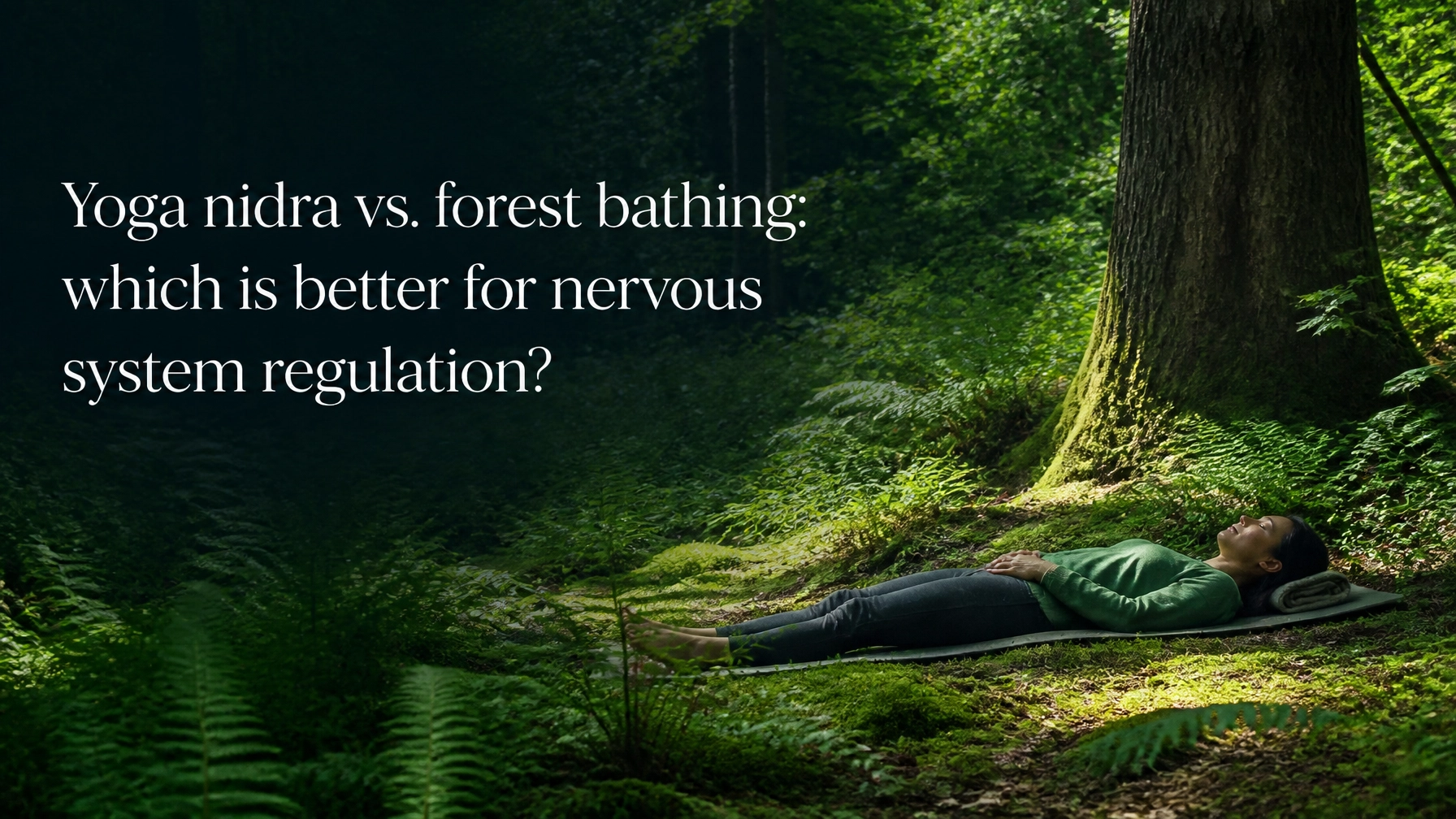
Yoga nidra vs. forest bathing: which is better for nervous system regulation?

When your system has been carrying too much for too long, choosing between stress reduction techniques can feel like another task. Should you lie down and follow a guided yoga nidra practice? Or step outside and spend time forest bathing among trees, birdsong and moss?
Both practices can support nervous system regulation. Both invite a shift away from constant mental activity. And both offer something our digitally saturated lives often lack: a return to direct, embodied experience.
But they do this in different ways.
The more useful question may not be, “Which one is better?” It may be: What does your nervous system need today : and how might these two pathways support one another?
What is nervous system regulation?
Your nervous system is continuously responding to the world around you. It helps you mobilize when action is needed and settle when the demand has passed.
When stress becomes chronic, the body may remain in a state of alertness even when there is no immediate danger. You may notice shallow breathing, muscular tension, restless sleep, digestive changes, racing thoughts or a persistent feeling of being “on”.
Nervous system regulation is not about being calm all the time. It is about developing greater flexibility : the ability to respond, recover and return to a sense of safety.
This is where practices such as yoga nidra and forest bathing may become supportive. They do not ask you to perform wellness perfectly. They create conditions in which the body can begin to rest.
Yoga nidra: regulation through guided inner awareness
Yoga nidra is an ancient relaxation practice traditionally undertaken while lying down comfortably. A guide leads you through a sequence of awareness, often including sensations in different parts of the body, natural breathing, imagery and a gradual return to ordinary awareness.
You are not required to stretch, balance or sit upright. You do not need to be physically fit, experienced in yoga or particularly good at concentrating.
The practice works with a gentle form of structured attention. Instead of trying to force the mind to become empty, you allow awareness to move slowly from one point to another. The body can soften while a quiet thread of consciousness remains present.
This is an important distinction for people who feel depleted. Yoga nidra is not another activity to master. It is an invitation to stop working at wellness and become receptive to rest.
What does the research suggest?
Research on yoga nidra is still developing, and the quality of studies varies. However, clinical studies and reviews have associated the practice with changes in several stress-related measures, including:
Reduced self-reported stress and anxiety
Changes in heart rate variability, a measure often used to study autonomic flexibility
Lower heart rate, blood pressure or cortisol in some study populations
Improvements in aspects of sleep quality
Observable changes in brain activity during the practice
A review published in Sleep Vigil describes yoga nidra as a state between waking and sleeping in which deep relaxation can occur without complete loss of awareness. You can read the review on the clinical relevance of yoga nidra.
In a randomized study of college professors, both yoga nidra and seated meditation were associated with reductions in stress and anxiety, with a tendency towards greater effectiveness of yoga nidra for anxiety symptoms. The study is small and has limitations, but it offers a useful insight: lying down and receiving guidance may be more accessible than asking an already-overloaded person to sit still and concentrate.
Yoga nidra also has a practical quality. It can be practised indoors, online or in a treatment room. It does not depend on the weather, the season or access to a forest.
Forest bathing: regulation through sensory relationship
Forest bathing, or shinrin-yoku, developed in Japan as a practice of spending time in a forest environment with openness and sensory awareness. It is not simply a brisk walk among trees. The pace is usually slow, with invitations to notice the shape of a leaf, the texture of bark, the temperature of the air or the changing quality of sound.
Forest bathing brings attention out of abstract thought and into relationship with the living world.

The forest becomes more than a backdrop. It becomes part of the experience.
You may hear birdsong behind you, feel the uneven ground beneath your feet, notice a shaft of green light across the path or sense the coolness held in moss. These details offer the nervous system varied, non-demanding sensory information. Nothing needs to be solved. Nothing needs to be optimized.
What does the research suggest?
Studies of forest bathing have associated time in forest environments with:
Short-term reductions in cortisol
Lower heart rate and blood pressure
Increased parasympathetic activity
Changes in heart rate variability
Reduced tension, anxiety and negative mood
Greater feelings of restoration and connection
A systematic review and meta-analysis of forest bathing research found that forest exposure may support short-term reductions in stress-related physiological markers. Other reviews have explored the effects of nature sounds, forest environments and sensory contact with the natural world.
At the same time, the evidence needs to be held with care. Forest bathing studies often differ in duration, location, season, activity and level of guidance. Many involve small groups and measure immediate effects rather than long-term outcomes.
This does not make the practice less meaningful. It simply reminds us not to turn nature into another promised solution. A forest is not a treatment machine. It is a living environment with which we enter into relationship.
Yoga nidra vs. forest bathing: the key differences
Both practices can support stress reduction, but they emphasize different pathways.
Yoga nidra may be especially supportive when you need:
A deeply restorative practice without physical exertion
A portable method you can use indoors or online
Clear guidance when your mind feels scattered
Support with settling before sleep
A structured way to reconnect with bodily sensations
A practice that does not depend on access to a natural environment
Forest bathing may be especially supportive when you need:
Sensory immersion and time away from screens
Gentle movement through a natural environment
Fresh air, natural light and contact with living systems
A wider perspective beyond the individual self
A relational experience of being with nature
Space for mood, attention and curiosity to recover
Neither practice is universally better. Your history, preferences, accessibility needs and current state all matter.
Someone who is highly activated may find the structure of yoga nidra reassuring. Someone who feels mentally compressed by indoor routines may need the spaciousness and sensory invitation of a forest. Someone with limited mobility may benefit from forest bathing adapted to a garden, park or window view : or from a guided practice indoors.
And sometimes the nervous system asks for both.
Why combine yoga nidra and forest therapy?
Yoga nidra guides attention inward, through the body and the changing landscape of awareness. Forest therapy techniques invite a renewed relationship with the more-than-human world.
One offers a structured inner pathway. The other opens a sensory and relational field around you.
EcoNIDRA™ brings these methodologies together as an equal fusion of Yoga Nidra and Forest Therapy techniques. It is not simply yoga nidra practised outside, and it is not forest bathing with a relaxation exercise added on. The two approaches are woven together from the beginning.
Nature co-guides the practice through live surroundings, carefully chosen nature soundscapes and nature-based visualizations. The session may take place outdoors, indoors or online, because the relationship with nature is not limited to one physical location.

A typical EcoNIDRA™ experience moves through three gentle journeys:
The sensory journey, which invites awareness of sound, touch, temperature and other sensory experiences
The pilgrimage through the body, inspired by the Yoga Nidra practice of rotating consciousness
The Earth journey, which opens attention towards nature, natural rhythms and our relationship with the living world
The pace is slow and embodied. You remain lying down in a position that feels supportive, while the guide offers simple, radically invitational language. At times, there may be no spoken guidance at all : only the soundscape of rain, wind, birds or other natural voices.
You are welcome to partner with a nature being or element: a tree, a river, a stone, the air moving through the canopy. Not as an abstract idea, but as a way of cultivating kinship.
Which practice should you choose?
If you are looking for one of the most accessible stress reduction techniques to begin with, yoga nidra may offer a gentle starting point. You can practise it without equipment, in a small space, and without needing to change your physical condition first.
If you have access to a woodland or green space and feel drawn towards sensory experience, forest bathing may offer a nourishing counterbalance to screen-based living.
You might also experiment with a simple rhythm:
Receive a guided yoga nidra practice when you need to rest deeply
Spend unhurried time outdoors when you need sensory spaciousness
Notice what changes in your breathing, muscle tone, sleep and sense of connection
Allow the practices to complement one another rather than turning them into a new performance
For wellness professionals, coaches, therapists, yoga teachers, forest therapy guides and healthcare practitioners, this integration can open a wider field of support. Some people are ready to walk slowly through a forest. Others are not. Some can lie down and listen. Others first need the safety of a familiar room.
A practice that can meet people in different places : without losing its depth : has something valuable to offer.
A pathway for like-hearted professionals
If you feel called to guide others into deeper rest and a more intimate relationship with nature, the EcoNIDRA™ Teacher Training offers a professional pathway into this unique blend.
The training explores the science and lived experience behind nervous system regulation, the structure of the EcoNIDRA™ journeys, nature soundscapes, embodied voice work and the art of guiding without force. It is designed for people who want to bring EcoNIDRA™ into coaching, therapy, yoga, healthcare, education, organizational wellbeing or nature-based work.
The online blended training is self-paced and can be completed at a spacious rhythm. You do not need to add another demanding project to your life. The intention is to learn in a way that honours rest as an active practice.
Perhaps the choice between yoga nidra and forest bathing was never meant to be a division.
Perhaps one helps you hear the quiet landscape within, while the other reminds you that you have never been separate from the living world around you. Together, they create a wider invitation : to rest, to sense, to belong and to return, gently, to your own human frequency.
Further reading
Written by
Kat Mertens