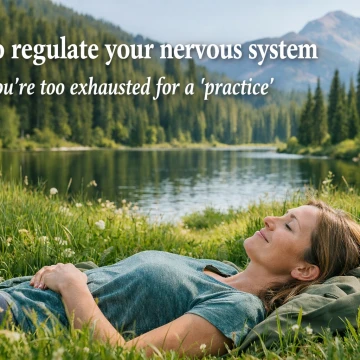
How to regulate your nervous system when you’re too exhausted for a 'practice'
I invite you to close your eyes for a moment, if it feels good and safe. Not to sleep, but just to feel the weight of your eyelids for a moment. To notice your body as it is, right now.
Many of us know this place: the kind of tired where even the idea of “self-care” can feel like another demand. The “good” tools start to look like chores. The yoga mat feels far away. Even a simple breath can feel like something to get right.
When we are truly exhausted, when the nervous system is stuck in a loop of high-alert survival or the heavy fog of shutdown, the last thing we need is another “practice” that requires effort. We don’t need more “working at wellness.” What we need is to be held. We need a way to return to ourselves that is as effortless as a leaf falling from a tree.
The burden of the ‘self-care’ checklist
In our modern, high-speed world, we’ve managed to turn even relaxation into a performance. We track our sleep with rings, we count our steps, and we “grind” through meditation apps. But for those of us navigating burnout, chronic stress, or simply the overwhelming weight of life, this “doing” is exactly what’s keeping us deregulated.
Your nervous system doesn’t need a 60-minute power flow or a complex visualization technique when it’s running on empty. It needs to know it is safe. It needs predictability, softness, and the permission to stop trying. When I first discovered the intersection of nature connection and deep rest, it was a revelation. I realized that my body didn’t want a “practice”; it wanted a sanctuary.
Why your nervous system craves the ‘effortless’
When we talk about nervous system regulation through nature, we are talking about moving from the “fight-or-flight” sympathetic state or the “freeze” dorsal vagal state back into the “social engagement” ventral vagal state.
But here is the secret: you cannot force your way into safety. Safety is felt, not thought.
If you are too exhausted to “practice,” you are actually in the perfect state for EcoNIDRA™. Why? Because this is a practice of radical receptivity. It is for those moments when you have zero energy left to give. It is for when you are horizontal, perhaps on the floor or the grass, and the only thing you can manage is to listen.
In these moments, the forest becomes our co-regulator. The trees, the soil, and the birds have a frequency that is steady and ancient. When we lie down among them, or even just listen to their sounds, our own frantic internal rhythm begins to mirror theirs. It is a process of entrainment. You don’t have to do anything; the trees do the work for you.
The art of horizontal living
There is something inherently healing about the horizontal. When we lie down, we signal to our brain that the “doing” part of the day is over. We give up the fight against gravity.
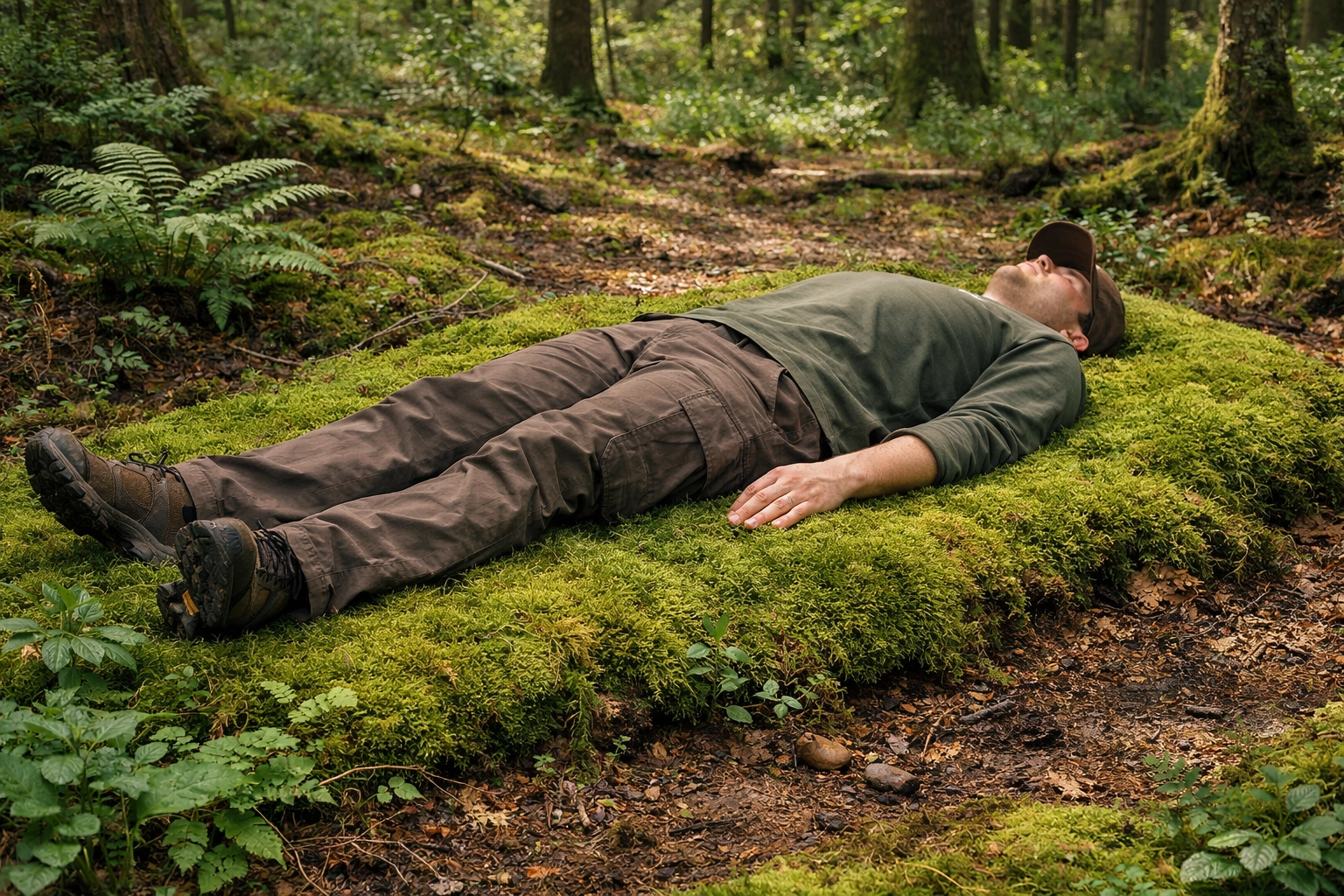
I often invite my students to find what I call “fertile ground.” This might be a literal patch of moss in the woods, or it might be a soft rug near a window where you can see the sky. The key is to stop trying to achieve a state of Zen. Instead, you are welcome to simply notice the points where your body meets the earth.
Sense the weight of your heels.
Feel the broadness of your pelvis.
Notice the space between your shoulder blades.
Let the back of your head be heavy.
In this state of “non-doing,” your nervous system begins to exhale. You aren’t “meditating at nature”; you are simply being with it. This subtle shift in language is vital. One requires an ego that directs attention; the other requires a soul that receives connection.
EcoNIDRA™: The bridge for the depleted soul
If you’ve ever wondered what is Yoga Nidra and how it differs from EcoNIDRA, think of it as a guided pilgrimage. Traditional Yoga Nidra is a powerful “sleep of the yogi.” EcoNIDRA™ is not “Yoga Nidra in nature,” but an equal blend of Yoga Nidra and Forest Therapy techniques: the ancient structure of guided yogic rest, held and deepened by the sensory, relational medicine of being with the living world.
When you are too tired for a practice, EcoNIDRA™ offers three journeys that require no effort from you:
1. A journey through the senses
Instead of trying to clear your mind (which is exhausting!), we invite the world in. You might notice the distant sound of a wood pigeon, the scent of damp earth, or the way the light filters through your eyelids. We aren’t judging these sensations; we are just letting them land on us, like soft rain.
2. A pilgrimage through the body
We rotate our consciousness through the body. This is a “rotation of consciousness,” a gentle flickering of awareness from one part to the next. You don’t need to “relax” your hand; you just need to sense it. If you fall asleep, that is okay. Your body knows what it needs more than your mind does.
3. A journey through the earth
We connect to the “nature beings” around us. This might be a specific tree you love or a landscape that feels like home. This connection reminds us that we are not isolated units of productivity; we are part of a vast, breathing ecosystem. As I shared in my own story of finding where Shavasana meets nature, this is where the healing truly happens.
Breaking the digital algorithm
We live in a time dominated by digital frequencies, pings, scrolls, and blue light. These are inherently deregulating. They keep us in a state of “continuous partial attention,” which is a low-grade stress response.
To regulate when you are exhausted, you must step away from the human-made frequency and return to the human frequency. The forest doesn’t have an algorithm. The wind doesn’t want your data. The radical authenticity of the natural world is the perfect antidote to the performative nature of the internet.
When you choose to lie down for 20 or 30 minutes with an EcoNIDRA™ session, you are making a revolutionary choice. You are saying that your rest is more important than your output. You are choosing regeneration over optimization.
Small steps for heavy days
If the idea of a full session still feels like too much, remember that regulation can happen in tiny, effortless increments.
The Window Gaze: Sit by a window and watch the trees for five minutes. Don’t look for anything specific. Just watch the movement of the leaves.
The Earth Touch: If you can, go outside and put your bare hands on a tree or the soil. Feel the texture, is it rough, cool, damp, or dry?
The Sound Bath: Open a window or step onto a balcony. Close your eyes and try to find the furthest sound you can hear. Then the closest.
These are not “tasks.” They are invitations to remember that you are alive and that you are supported by something much larger than your own willpower. As many have discovered, even 15 minutes in a “nature room” can drop stress significantly. Imagine what a deep, guided rest could do.
An invitation to hold space
Perhaps you are someone who usually holds space for others, a coach, a therapist, a teacher, or a parent. If you are feeling depleted, it may be because you have been “giving” from a dry well.
Learning to guide these practices isn’t just about adding a tool to your professional kit; it’s about learning to nourish yourself first. Many professionals are switching to EcoNIDRA™ because it offers a way to facilitate deep healing without the facilitator having to “perform.” You become a bridge, allowing nature to do the heavy lifting of regulation.
The trees will wait
The next time you feel that heavy cloud of exhaustion, please don’t reach for a “self-improvement” book. Don’t force yourself through a workout. Instead, you are welcome to find a soft place to lie down.
Listen to the breath of the wind. Feel the support of the floor beneath you. Let go of the need to be “better” and instead, just be here. The nervous system doesn’t need a map; it needs a home. And nature is the oldest home we have.
If you feel called to explore this path of radical rest: either for your own healing or to guide others: I invite you to look into our Teacher Training. It is a journey back to the senses, back to the earth, and ultimately, back to that sparkling glans in your eyes that exhaustion has temporarily dimmed.
The trees have been here for centuries. They aren’t in a rush. They will wait for you to find your breath again.
Written by
Kat Mertens